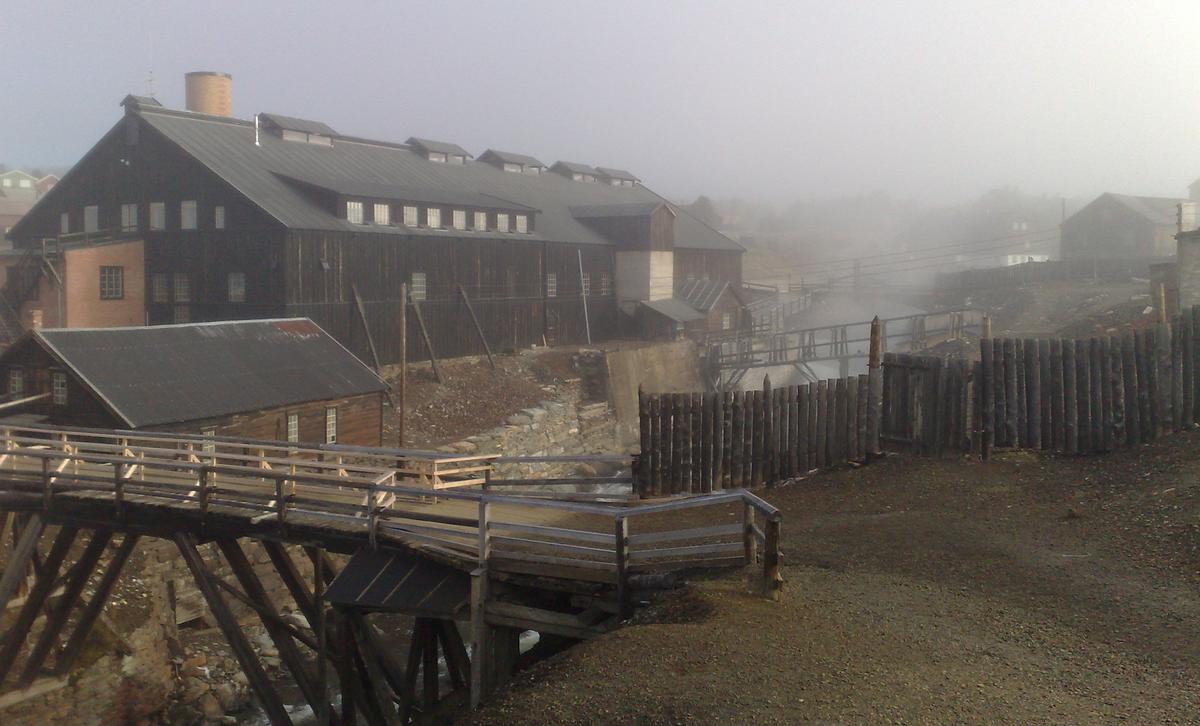
The New Method of Smelting
From the year 1887 ‘turn-roasting’, black-copper smelting and refining were all discontinued at the main smelting house in Røros.
Alexander Austnes
| Converter in the Smelting House at Røros. Ca. 1890. Photo: Iver Olsen |
With the introduction of the Bessemer process, the ore was ‘first roasted’ and copper matte smelted, the then molten copper ore was introduced into a converter. Impurities were removed by forcing air into the molten mass.
Shortly after this new process was started, in June 1888, the smelting house caught fire, however, by November of the same year, a new smelting house was in operation. The new house was now equipped with 2 matte smelting furnaces,
a Bessemer converter and a refining furnace.
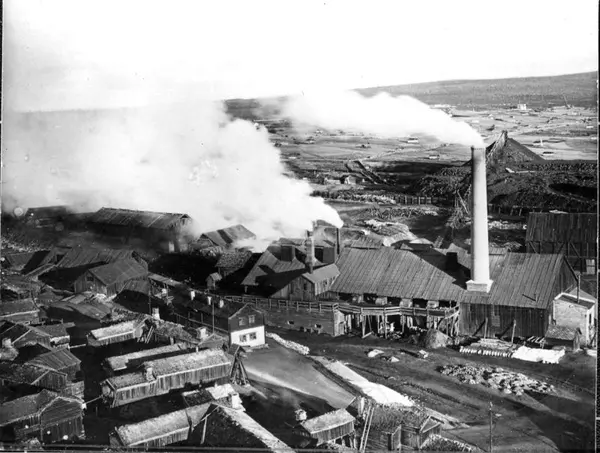
| The Smelting House at Røros in 1894. Photo: Iver Olsen |
The introduction of the Bessemer system was an enormous improvement in the smelting process at the Røros Copper Works. Extraction of the copper from copper ore using the old 5 step process could take up to one and a half months, the new method reduced the time to, one and a half hours, and, after refining, the end product had a copper content of 99.8%.Further improvements in the production of copper were introduced with the flotation process. The Company’s flotation plant at Storwartz was started up in 1926. The flotation plant produced a copper concentrate of approx. 25% copper. The introduction of the flotation process at Storwartz led to the cessation of primary roasting at the smelting house in Røros.